Choose a Rulebook
A lead publishes a document describing standards for a particular community or service.
 About the project
Exonym / Rulebooks
Decentralized Rulebooks were designed to make trust signals and permissions portable across the web.
The premise
A Rulebook is a public document setting out rules or standards for a particular online context. People can join one and receive a credential showing that they meet its requirements. They can then present that credential across services, without every service needing to create its own closed trust system.
The design aims to combine privacy with accountability: a person can demonstrate compliance without necessarily revealing their identity, while a breach can affect the validity of their credential.
How it was designed to work
A lead publishes a document describing standards for a particular community or service.
A participant receives a portable credential that can serve as a verifiable trust signal.
Moderation and revocation processes can respond when a rule is broken.
The design
Instead of a generic badge controlled by one platform, the idea is a signal tied to a specific set of publicly readable rules. People can inspect who set those rules, how they are managed, and what a credential actually says.
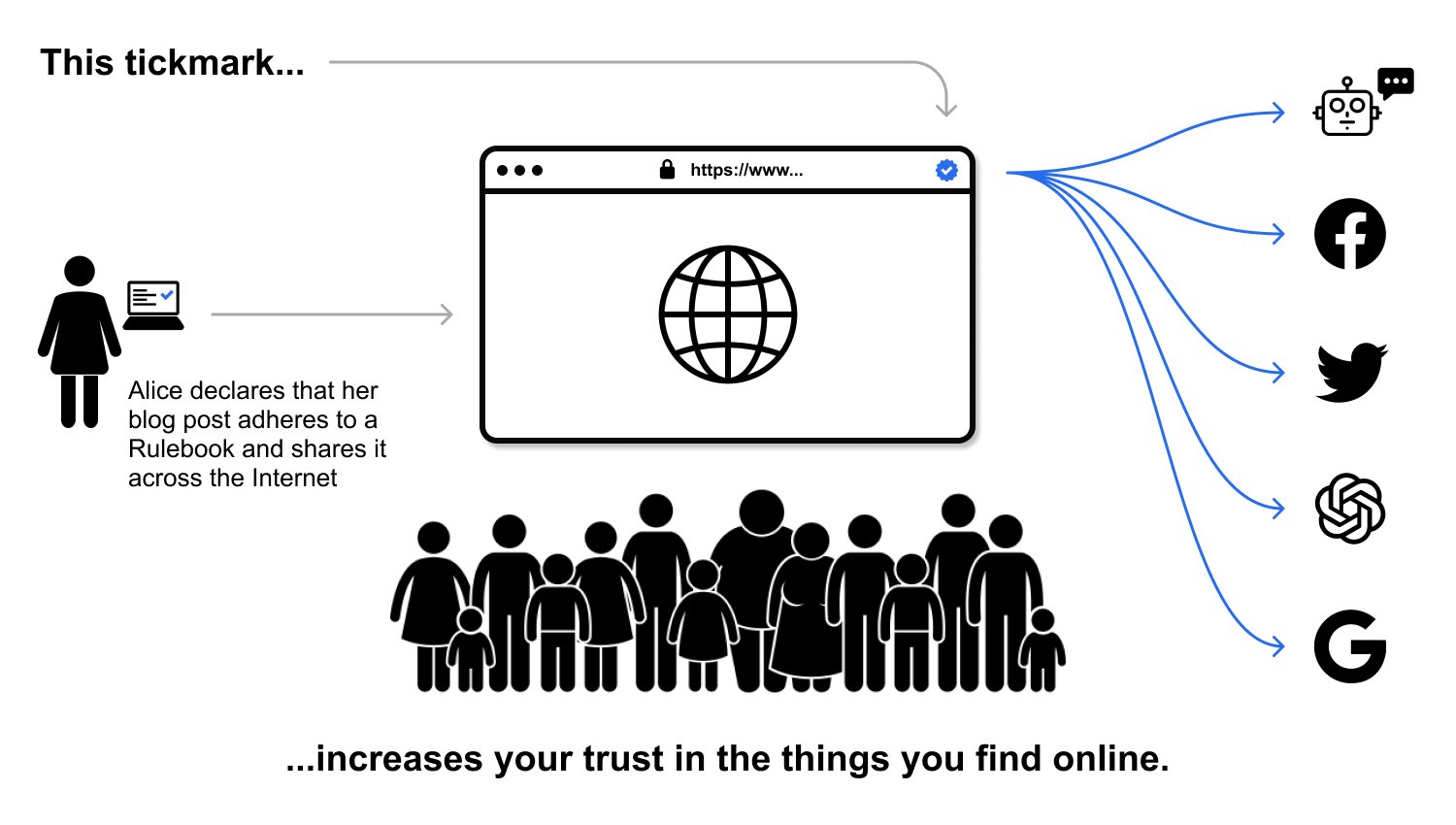
The wider architecture separates rule-setting, moderation, and participant credentials. It was intended as a framework others could adapt to their own context.
Read the technical introductionFurther reading
The essays explore the mechanics of Rulebooks and their possible applications in AI governance, news media, and the information age.
Read the essays